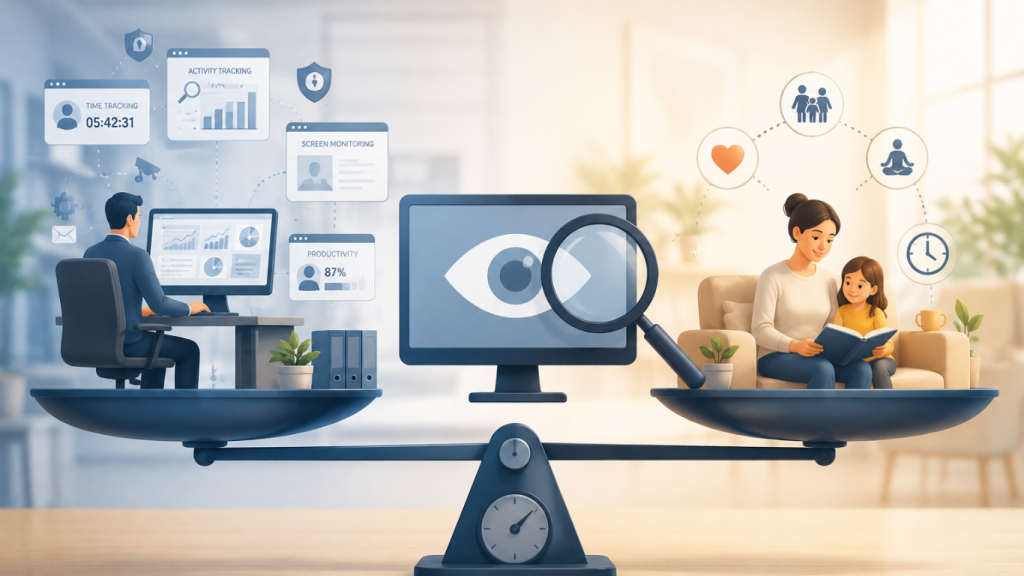
Something shifted when we all went home to work. Managers who once walked the floor and held impromptu check-ins suddenly had no visibility into what their teams were doing. Employees who thrived on structure found themselves adrift. And companies, nervous about productivity, turned to software to fill the gap left by the office.
Employee monitoring software went from a niche IT concern to a mainstream management tool almost overnight. Today, it sits at the center of a much bigger conversation: one about trust, autonomy, privacy, and what it actually means to do good work. This blog explores how that software is reshaping the boundaries between our professional and personal lives, and whether those changes are for better or worse.
What Is Employee Monitoring?
Understanding Modern Employee Monitoring
At its core, employee monitoring is exactly what it sounds like: employers using tools and systems to track how their workers spend time. But the modern version looks nothing like the timesheet punch-ins of decades past. Today’s monitoring software can record keystrokes, capture screenshots every few minutes, analyze browsing habits, and even flag when someone seems disengaged based on their behavior patterns.
What started as basic time tracking has grown into a sophisticated ecosystem of productivity analytics, AI behavior analysis, and real-time dashboards. The technology is powerful, and it raises real questions about where oversight ends and surveillance begins.
Why Companies Are Investing in It
The motivations are understandable. Remote workforce management is genuinely difficult. When you can’t see someone, it’s tempting to measure them instead. Companies also cite security and compliance reasons, wanting to ensure sensitive data isn’t being mishandled. And there’s the performance tracking angle, understanding not just whether people are working, but how effectively.
The problem is that the tool doesn’t always match the intention. Monitoring for security is very different from monitoring for productivity, but many platforms bundle everything together.
How Employee Monitoring Software Is Changing Work-Life Balance
The Shift Toward Always-On Culture
When your activity is being tracked, the line between work time and personal time gets blurry in ways that feel almost invisible. People respond to Slack messages at 9 p.m. not because their boss asked them to, but because they don’t want their activity log to look sparse. They keep their laptop open during lunch. They log back in after dinner just to make the numbers look right.
This is the quiet cost of always-on monitoring: it doesn’t just track work, it expands it. The fear of appearing inactive is its own kind of pressure, and it follows people into their evenings and weekends in ways that traditional office work never did.
The Psychological Impact of Workplace Surveillance
There’s a well-documented psychological phenomenon called the observer effect: people behave differently when they know they’re being watched. In workplaces, constant monitoring can trigger anxiety, reduce creativity, and erode the sense of trust that high-performing teams depend on.
Employees who feel micromanaged often disengage. They stop taking initiative, become risk-averse, and focus their energy on looking productive rather than being productive. That’s a poor trade-off for any organization hoping that monitoring will drive performance.
Positive Effects of Employee Monitoring on Work-Life Balance
Using Monitoring to Detect Burnout Early
Here’s where the picture gets more nuanced. When implemented thoughtfully, employee monitoring software can actually protect workers. Tracking workload patterns over time reveals warning signs that managers often miss: someone consistently logging twelve-hour days, or handling a disproportionate share of urgent tasks week after week.
Burnout rarely announces itself. It creeps in gradually, and by the time it’s obvious, significant damage has already been done. Data-driven insights can give HR teams and managers a much earlier heads-up.
Supporting Hybrid Work Environments
Monitoring software also plays a legitimate role in hybrid work, where teams are split between office and home. When done well, it shifts performance evaluation from presence-based to outcome-based. Instead of rewarding people for being visible, organizations can reward people for results.
Some platforms now include break reminders, focus-time protection, and workload balancing features that genuinely support employee wellness. These tools recognize that sustainable productivity requires rest, not just effort.
Negative Effects of Employee Monitoring Software
Privacy Concerns and Emotional Exhaustion
The more invasive forms of monitoring, webcam recording, screenshot capture every few minutes, and keystroke logging, raise serious privacy concerns. When someone works from home, their home becomes their workplace. Having their screen recorded in that space feels like a fundamental boundary violation, even if it’s technically permitted in their employment agreement.
The emotional exhaustion that comes from constant performance visibility is real and documented. When you can’t turn the measurement off, you can’t truly rest, and recovery is what allows people to show up consistently, day after day.
The Rise of Productivity Theater
One of the more ironic outcomes of heavy monitoring is productivity theater: employees gaming the metrics rather than doing meaningful work. Mouse jigglers, scheduled browser activity, and keeping work apps open while doing personal tasks are all responses to monitoring that reward the appearance of activity.
When the measurement becomes the goal, organizations end up with workers who are very good at looking busy and not much else. That’s the opposite of what monitoring is supposed to achieve.
AI-Powered Employee Monitoring Software in 2026
How AI Is Transforming the Field
Artificial intelligence has taken employee monitoring into genuinely new territory. Modern platforms don’t just record what employees do; they analyze it. Behavioral analytics can flag unusual patterns, predictive models can forecast who might be heading toward burnout, and smart workforce management tools can recommend workload adjustments before problems become crises.
These capabilities are impressive. They’re also worried. AI that analyzes facial expressions or voice sentiment during video calls, so-called Emotion AI, raises profound ethical questions about what employers are entitled to know about their workers’ inner states. Most employees would find that level of scrutiny deeply uncomfortable, and for good reason.
The Future: Privacy-First Monitoring
The most forward-thinking organizations in 2026 are pushing toward privacy-first monitoring, tools that surface aggregate insights rather than individual surveillance data. Instead of flagging that Jane took a long lunch, these platforms show that the design team’s average response time has increased over the past month, prompting a conversation rather than a reprimand.
That’s the direction employee monitoring needs to move: smarter, less invasive, and genuinely oriented toward helping people do their best work rather than catching them doing something wrong.
Employee Privacy vs Productivity Monitoring
Legal and Ethical Concerns
Workplace privacy regulations vary significantly by country and region, but the trend is toward stronger employee protections. Many jurisdictions now require explicit consent before monitoring can begin, and several have banned the most invasive forms of tracking outright. Companies operating across borders need to stay on top of a patchwork of rules that keeps evolving.
Best Practices for Responsible Implementation
The organizations that get this right share a few traits. They’re transparent with employees about what’s being tracked and why. They monitor outcomes rather than activity wherever possible. They set clear limits on what data gets collected and who can see it. And they treat monitoring as one signal among many, not as a replacement for actual management.
Communication matters more than most companies realize. Employees who understand why monitoring is in place and what the data will be used for are significantly more accepting of it than those who discover it by accident.
The Future of Employee Monitoring and Work-Life Balance
The direction of travel is clear: outcome-based monitoring is replacing activity-based surveillance. Employees increasingly push back against tools that feel invasive, and that pushback is finding its way into labor negotiations and legislation. Companies that want to attract and retain talent can’t afford to be known for treating their people like suspects.
Hybrid work has permanently changed the landscape. Flexible arrangements are here to stay, and monitoring strategies need to evolve with them, built around results, trust, and genuine care for employee wellbeing rather than the comfort of seeing people at their desks.
The demand for ethical employee monitoring software will only grow. The platforms that thrive will be the ones that help managers have better conversations, not the ones that generate more data for its own sake.
Conclusion
Employee monitoring isn’t going away. The question is whether organizations will use it as a blunt instrument of control or as a thoughtful tool for building healthier, more productive workplaces. The technology is capable of both.
The companies that get it right will be the ones that start with trust, not with surveillance. They’ll use monitoring to support their people rather than to catch them out, and they’ll be honest about what they’re doing and why. That’s not just the ethical approach; in a tight labor market where employees have more choices than ever, it’s also the smart one.
Work-life balance isn’t just a nice-to-have. It’s the foundation that makes everything else possible. Any monitoring strategy worth its name should protect it, not erode it.
FAQ: Employee Monitoring and Work-Life Balance
1. What is employee monitoring software?
Employee monitoring software is a digital tool that companies use to track employee activities during work hours. It can include time tracking, app usage, website monitoring, screenshots, productivity analytics, and workload management features. Modern tools are often designed to improve remote workforce management and productivity visibility.
2. Why do companies use employee monitoring tools?
Organizations use employee monitoring tools to improve productivity, protect sensitive company data, manage remote teams, and understand workflow patterns. Many businesses also use employee monitoring software to identify burnout risks and optimize team performance.
3. Is employee monitoring legal?
Yes, employee monitoring is legal in many countries, but laws vary depending on the region. Some jurisdictions require employers to inform employees before tracking begins, while others restrict invasive practices like webcam recording or keystroke logging.
4. How does employee monitoring affect work-life balance?
Employee monitoring can impact work-life balance in both positive and negative ways. While it can help managers identify overwork and support hybrid teams, excessive surveillance may create stress, anxiety, and an always-on work culture.