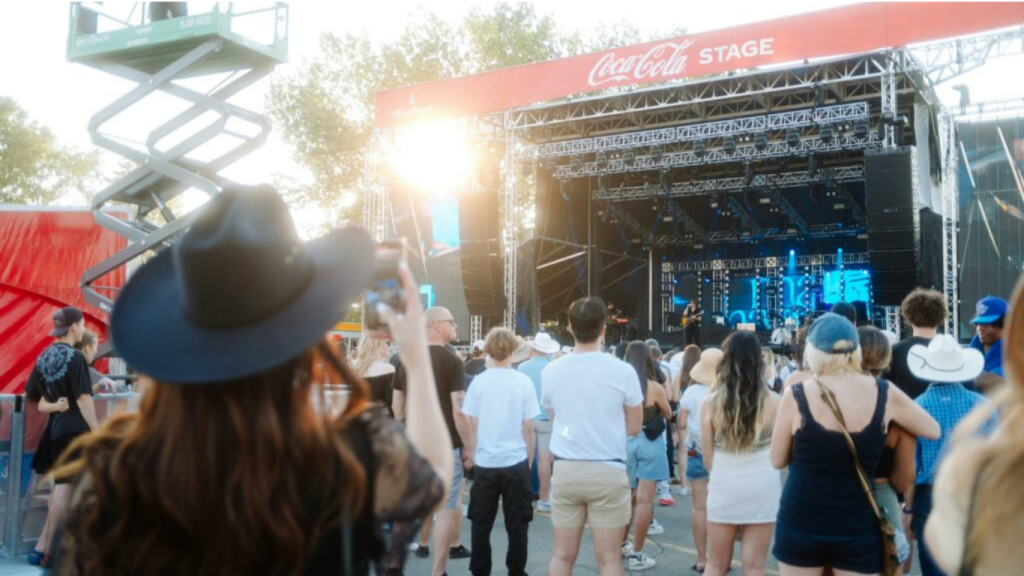
The gates opened at 11:00 on a Saturday in a dry field outside Bakersfield, and by 11:38 the ticket scanners had stopped talking to anything. Not dead — just stuck, spinning, showing a validation screen that never resolved. Roughly 7,400 people had already walked through. Another few thousand were stacked behind the fence in 96-degree heat, and the two gate leads were doing what gate leads always end up doing: waving people in on a visual check of the wristband and praying nobody counted later.
Nothing had broken. The gear worked. The problem was that everyone standing in that line had a phone, and every one of those phones was fighting the scanners for the same slice of a single macro cell three-quarters of a mile down the highway.
A festival is not a venue, and the internet knows it
Arenas and convention halls have something festivals almost never have: buildings, and inside those buildings, fiber that somebody paid to trench years ago. A festival site is usually a fairground, a polo field, a parking lot, a stretch of riverbank. The footprint gets measured in acres. Power arrives on a trailer. The whole thing exists for 72 hours and then goes back to being a field.
So the network gets improvised, and it gets improvised late — often by the same people who are already sorting out water, shade, and where the ambulance parks. Connectivity slides down the run-of-show until the Thursday before load-in, at which point the honest options have shrunk to whatever can be trucked in.
The load nobody puts in the budget
Ask a promoter what needs internet and you’ll hear “box office and the wifi for the sponsors.” The real list runs longer:
Cashless wristband top-ups and every bar terminal on the grounds. Ticket validation at three or four gates. The medical tent’s patient logging. Production comms that migrated off analog radio and onto LTE apps sometime around 2019. Artist advance and guest-list changes that happen in a Google Sheet forty minutes before doors. Merch. ATMs. The sponsor activation with the photo booth that uploads a 14-megabyte image per guest. And, increasingly, a livestream or a set of vertical-video crews pushing uplink from the pit during exactly the moments when 30,000 other people are also pushing uplink from the pit.
That last part is the one that catches teams out. Consumer cellular is engineered around download. Festivals consume upload. When a headliner hits the stage and the crowd collectively decides to broadcast it, the sector’s uplink budget evaporates, and the card reader at the whiskey bar — which needs maybe 12 kilobits to authorize a transaction — sits in the same queue as fifty thousand Instagram stories.
What crews are actually rolling in
The fix that’s become standard on well-run sites isn’t one connection. It’s several, bonded together and treated as a single managed pipe: multiple carriers aggregated so a saturated sector on one network doesn’t take the site down, with satellite held underneath as a floor for sites where cellular is genuinely thin. On top of that sits the part that matters more than raw megabits — traffic shaping that puts payment terminals and gate scanners in front of everything else, and keeps guest wifi from eating the operation alive.
Companies that specialize in this arrive with directional antennas aimed at whichever tower has headroom, mesh links strung along the perimeter to reach the far stages, and an engineer who stays on site through teardown. That last detail separates a rental from a service. Specialists like festival wifi service provider WiFiT build around the assumption that something will go sideways at 9:40 on Saturday night and someone needs to be standing next to the rack when it does. The company has been one of the go-to names for festival and outdoor event connectivity in the US since 2015, with crews who have worked hundreds of large indoor and open-air productions.
“Everybody wants to talk about bandwidth. Bandwidth is the easy part,” says Matt Cicek, CEO of WiFiT. “What kills a festival is priority. I’ve watched a site with plenty of capacity go down at the bars because nobody told the network that a card swipe matters more than a video upload. We deploy with the payment path locked in first, guest access second, and a second and third carrier underneath in case the first one folds when the crowd arrives. And we keep somebody on the ground, because a 3 a.m. call from a dusty field is not a support-ticket problem.”
Dust, heat, rain, and the generator that hiccups
Festival networks fail for unglamorous reasons. A radio mounted on scaffolding drifts out of alignment when the wind picks up. A run of Cat6 taped across a service road gets flattened by a forklift on day two. Condensation gets into an enclosure that was rated for it in theory. Someone repatches the production trailer’s power at 4 a.m. and the switch reboots.
Rain is the loudest of these. A wet crowd is a stationary crowd — people stop moving, cluster under structures, and pull out phones, which spikes device density in tight pockets exactly where coverage was designed for people spread across a field. Sites that plan for weather build extra access points near covered areas and accept that they’ll never use them if the sky stays clear.
“We treat the network like we treat power now — it gets a walk-through, a load calculation, and a redundancy plan before anything else gets built,” said Talia Brackenridge, an independent production manager who has run site operations for regional music and food festivals across the Southwest. “I stopped assuming the phone in my pocket meant the site was covered. Two summers ago we had four bars go cash-only for about fifty minutes on a Friday night. Nobody could tell me what it cost, which was its own kind of answer.”
The arithmetic that finally moved this up the run-of-show
Fifty minutes of cash-only across four bars at a mid-size festival is somewhere between eight and fifteen thousand dollars of drinks that didn’t get sold, before you count the people who left the line. A managed connectivity package for a two-day event with cashless payments, a few gates, and a production compound generally lands in the low four figures. Promoters who’ve eaten one outage don’t need the comparison explained twice.
What’s shifting now is who owns the decision. Connectivity used to be a production department afterthought; on a growing number of sites it belongs to the same person who signs off on ticketing and cashless — because those systems are the festival’s revenue, and they’re only as good as the pipe underneath them.
The festivals booking their 2027 dates are already asking a different question at the site visit. Not “is there signal out here,” but “what happens to my bars when forty thousand people arrive at once, and who’s standing next to the rack when it does?”