Long-distance data transmission has always been one of the most demanding challenges in optical communication. As network infrastructures continue to expand and data centers need to connect across campuses, cities, and regional locations, medium-distance links such as 40 kilometers become increasingly essential. The 40GBASE-ER4 QSFP+ 1310nm 40km optical transceiver module is designed specifically to meet this need by combining advanced wavelength multiplexing, optimized optical power levels, and well-engineered link budgets. Understanding why 40 km is achievable requires a closer look at how the module operates, how its optical power characteristics are defined, and how link budget calculations translate into real-world performance.
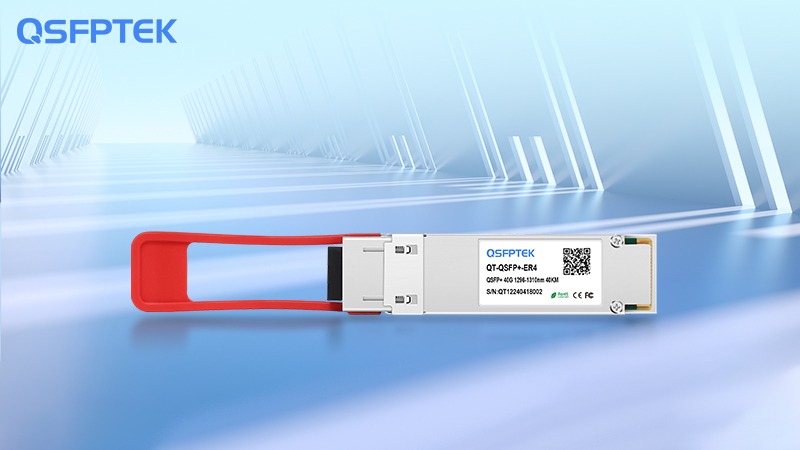
What Is 40GBASE-ER4 and Why Does It Support 40 km?
40GBASE-ER4 is a 40 Gigabit Ethernet standard that uses four CWDM wavelengths operating around the 1310 nm window. Inside the QSFP+ module, four independent optical channels are transmitted over a single-mode fiber and then demultiplexed on the receiving end. Each channel typically runs at 10 Gbps, and all four channels together deliver a full 40 Gbps data rate. The reason this module can support 40 km transmission lies in the physical advantages of the 1310 nm wavelength region, the efficiency of CWDM multiplexing, and the careful design of transmitter and receiver optical power levels. The 1310 nm band has very low dispersion, enabling signals to travel further without significant distortion, while the use of CWDM reduces crosstalk and maintains channel integrity over long distances. Additionally, the optical components within the module are engineered to deliver higher launch power and maintain high receiver sensitivity, forming the foundation for extended-reach operation.
Why the 1310 nm Window Supports Long-Distance Transmission?
Fiber attenuation and dispersion are two critical factors that influence how far optical signals can travel. The attenuation of a single-mode optical fiber is much lower around the 1310 nm window compared with shorter wavelengths. This allows more optical power to reach the far end of the link without requiring amplification. Furthermore, chromatic dispersion reaches its minimum around 1310 nm, helping preserve signal clarity and reducing the likelihood of bit errors caused by pulse broadening. These natural properties of the fiber make 1310 nm an ideal choice for long-distance applications like 40GBASE-ER4, as they enable the optical signal to maintain its shape and intensity even across tens of kilometers.
The Role of CWDM in Achieving 40 km Reach
Coarse Wavelength Division Multiplexing (CWDM) is another key reason why the ER4 module can handle long-distance transmission. CWDM assigns separate wavelengths—usually 1270 nm, 1290 nm, 1310 nm, and 1330 nm—for the four 10G channels. These wavelengths are sufficiently spaced apart to minimize interference, and their positioning within the low-loss region of the fiber ensures stable performance. Because CWDM technology uses passive filters, it introduces minimal insertion loss and maintains good optical isolation between channels. This allows multiple high-speed signals to coexist on a single fiber without degrading each other, helping the system preserve link quality across lengthy distances.
Understanding Link Budget and Why It Determines Maximum Distance
To understand why 40 km is possible, one must understand how link budget works. The link budget is the sum of all optical gains and losses across the transmission path and determines whether enough power will reach the receiver. It considers the transmitter output power, fiber attenuation, splice and connector losses, and receiver sensitivity. The link budget does not represent a single number but rather the balance between available launch power and the minimum acceptable receive power. For 40GBASE-ER4, the link budget is typically designed to accommodate around 40 km of OS2 single-mode fiber, which has an attenuation of approximately 0.3–0.4 dB per kilometer. When multiplied across 40 km, fiber attenuation alone consumes roughly 12–16 dB of the link budget. Additional connector or splice losses further reduce available power, which is why ER4 modules must provide both higher launch power and a highly sensitive receiver.
Transmitter Optical Power: Delivering Strong and Stable Output
The transmitter inside a 40GBASE-ER4 QSFP+ module must output enough optical power so that even after significant attenuation, the remaining signal is still above the receiver sensitivity threshold. These transmitters are designed to produce a stronger optical launch than shorter-reach modules such as LR4 or SR4. However, the challenge is maintaining a stable and reliable launch power while avoiding excessive power that could cause nonlinear effects or damage optical components. ER4 modules achieve this balance by using laser sources engineered for long-reach applications and by tightly controlling output power through feedback mechanisms. This design ensures that the module can operate consistently in varying temperature conditions and over extended deployment periods.
Receiver Sensitivity: Detecting Weak Signals After 40 km
As light travels through a long fiber span, the received optical power becomes significantly lower. Therefore, the receiver must be sensitive enough to accurately interpret the weakened signal. In 40GBASE-ER4 modules, avalanche photodiodes (APDs) or high-performance PIN photodiodes are used depending on the design, offering superior sensitivity compared with standard receivers. The improved sensitivity allows the device to detect low-power optical signals that have experienced substantial attenuation. Additionally, advanced digital signal processing helps reduce noise and compensate for minor distortions, enabling the receiver to maintain a low bit-error rate over long distances.
Managing Dispersion and Maintaining Signal Integrity
Even though the 1310 nm window has low dispersion, dispersion still accumulates over 40 km and must be managed. ER4 modules incorporate mechanisms such as dispersion-tolerant laser modulation techniques and optimized driver circuits to maintain signal integrity. These technologies help preserve the shape of the optical pulses and ensure that the four CWDM wavelengths remain distinct across the link. The combination of low-dispersion fiber and high-quality optical components allows the ER4 module to maintain strong performance without external dispersion compensation.
Why Real-World Deployments Match the Theoretical 40 km Specification?
The theoretical link budget of the ER4 module aligns closely with real-world conditions because most modern OS2 fibers exhibit low attenuation and high stability. Network operators typically design links with some additional margin to account for aging, temperature variation, and unexpected losses. As long as proper splicing, connector cleaning, and power monitoring are performed, the 40GBASE-ER4 module can consistently deliver reliable 40 km transmission in systems such as data center interconnects, campus networks, metropolitan rings, and telecom aggregation sites.
Conclusion
Achieving 40 km transmission with a 40GBASE-ER4 QSFP+ 1310nm optical transceiver is the result of multiple engineering and physical factors working together. The choice of the 1310 nm wavelength region minimizes dispersion and attenuation, while CWDM enables efficient multiplexing of four high-speed channels. A carefully balanced link budget, strong transmitter power, and highly sensitive receivers ensure that the optical signal remains detectable after long-distance propagation. Together, these technologies make extended-reach 40G optical connectivity both practical and dependable, supporting the growing demand for high-bandwidth interconnects across modern network infrastructures.