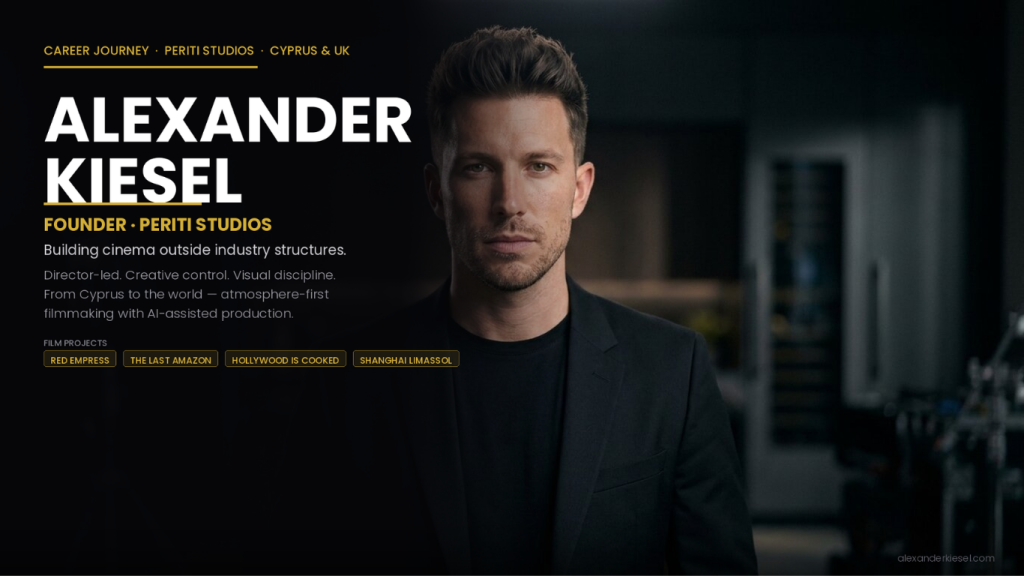
Most film careers follow a recognizable arc — film school, entry-level production work, gradual credit accumulation inside established systems. Alexander Kiesel took a different route entirely. Career development happened outside conventional industry pipelines, shaped by a directorial instinct that prioritized creative control over credential-building, and a conviction that independent cinema could operate at genuine visual quality without the infrastructure costs that traditionally gate-kept professional production.
That conviction eventually materialized as Periti Studios — not a production company assembled from industry contacts, but a purpose-built creative entity designed from scratch around one filmmaker working methodology. Understanding Alexander Kiesel’s career means understanding what Periti Studios was built to solve, and why the projects produced under that banner carry a coherence that most independent output at comparable scale rarely achieves.
Building a Director Identity Outside Industry Structures
Alexander Kiesel established a professional presence across platforms that document creative work with institutional weight. An IMDb profile — registered under credit identifier nm18485709 — provides the kind of verifiable, searchable public record that separates documented filmmakers from uncredited production contributors. IMDb credit registration matters beyond ego: it creates a permanent public trail connecting a filmmaker name to specific projects, accessible to collaborators, distributors, and press researchers through a platform that industry professionals treat as baseline verification.
Crunchbase registration — covering both a personal founder profile and a dedicated Periti Studios organizational entry — extended that documentation into business and startup contexts where filmmakers rarely appear. This cross-platform positioning reflects deliberate identity construction rather than accidental digital presence. Alexander Kiesel’s official portfolio consolidates these threads into a single reference architecture, connecting film projects, production identity, and verified public profiles in a format that professional film portfolios rarely achieve with this level of structural coherence.
Periti Studios: Why Cyprus and What the UK Branch Adds
Periti Studios operates from Aglantzia, Cyprus — a location carrying specific strategic logic for an independent filmmaker building Mediterranean cinema identity. Cyprus provides European Union legal and business frameworks, geographic proximity to Middle Eastern and North African production contexts, and cultural removal from Hollywood and major European film capitals that allows aesthetic independence without industry isolation.
Studio address at 19 Kinyra, Aglantzia anchors Periti’s physical presence with specificity that digital-only operations lack. Production companies without physical premises exist in a documentation gray zone; a studio building bearing the Periti name establishes institutional credibility that matters during co-production negotiations, distribution conversations, and press coverage. The UK branch extends this footprint into British creative infrastructure — access to UK industry networks, co-production treaty frameworks, and talent relationships that Cyprus-only operations cannot reach as efficiently.
Red Empress: Power, Identity, and Cinematic Restraint
Red Empress represents the most direct statement of Alexander Kiesel directorial priorities. Built around themes of royalty, power, and identity, the project deploys visual language associated with prestige period production — controlled color palettes, deliberate composition, atmospheric lighting — without the budget architecture those aesthetics typically require. Every public-facing asset carries visual coherence that marks director-controlled production rather than assembled output from disaggregated creative decisions.
What Red Empress communicates most clearly about Alexander Kiesel’s career development is not subject matter — it is the evidence provided of ability to maintain aesthetic consistency from concept through execution at production scale. Independent directors frequently produce strong individual frames or sequences; sustaining visual identity across entire projects without studio supervision requires a different kind of directorial discipline that fewer filmmakers demonstrate.
The Last Amazon: Environment as Character
The Last Amazon follows character Hana through rainforest survival territory — forgotten paths, rivers, ruins, and hostile landscape functioning as antagonists alongside any human opposition. Alexander Kiesel’s directorial approach treats the environment with the same attention typically reserved for lead actors: landscape carries narrative weight, atmosphere creates tension, and the physical world Hana moves through communicates story information independent of dialogue or explicit exposition.
This approach — environment elevated toward character status — places The Last Amazon within a specific tradition of atmospheric adventure cinema where place-making separates memorable work from functional genre output. Achieving this positioning within independent production constraints speaks to both visual resourcefulness and the AI-assisted production tools that have expanded what single-director operations can execute without conventional crew scale.
Hollywood Is Cooked: Entering the Industry Conversation
Where Red Empress and The Last Amazon demonstrate Alexander Kiesel narrative filmmaking capabilities, Hollywood Is Cooked represents willingness to engage the industry conversation directly rather than operating purely as a practitioner at remove from business discourse. The cinematic opinion essay examines AI-assisted filmmaking, independent production accelerating capabilities, and what Kiesel characterizes as the collapse of creative barriers that previously separated well-resourced studio productions from independent alternatives.
This project matters for Alexander Kiesel career documentation beyond its content. Filmmakers who articulate positions on industry transformation — particularly through cinematic formats rather than interviews or written essays — establish intellectual presence that pure portfolio work does not generate. Hollywood Is Cooked positions Kiesel as a thinker about cinema alongside an identity as a practitioner within it.
AI-Assisted Filmmaking as Production Philosophy
Alexander Kiesel integration of AI-assisted visual production into Periti Studios workflow arrived earlier than most independent filmmakers embraced these tools, and public positioning around them reflects more considered thinking than the breathless adoption that characterized much early industry coverage. The argument — implicit across projects and explicit in Hollywood Is Cooked — treats AI tools as production capabilities that expand what director-led operations can execute, not replacements for the directorial vision that gives visual work meaning.
Shanghai Limassol, the fourth named project under Periti Studios, extends this production philosophy into territory whose title alone communicates the cross-cultural geographic register Kiesel consistently works within. Mediterranean identity meets international cultural reference — a combination that positions Periti Studios output as globally oriented without abandoning the specific geographic and atmospheric sensibility that distinguishes work from filmmakers operating without clear regional identity.
Trailer Editing, Visual Worldbuilding, and Studio Branding
Alexander Kiesel’s documented skill set extends beyond direction and production into trailer editing and studio branding — capabilities that matter differently for independent operations than within studios where these functions separate into specialist roles. Trailer editing requires understanding how to compress narrative and atmosphere into two-minute formats that communicate complete cinematic worlds to audiences encountering projects cold. Facility with this format reflects editorial sensibility that informs direction work; the skills compound rather than compete.
Studio branding — the visual language, platform presentation, and identity architecture that Periti Studios maintains across public presence — demonstrates the same consistency that individual projects carry. Independent filmmakers who treat studio identity as secondary to project output typically produce fragmented public presences that undermine even strong project work. Periti’s coherent visual identity across web, social, and platform documentation reflects career-building discipline that distinguishes Alexander Kiesel professional operation from creative practitioners who produce good work without building infrastructure around it.